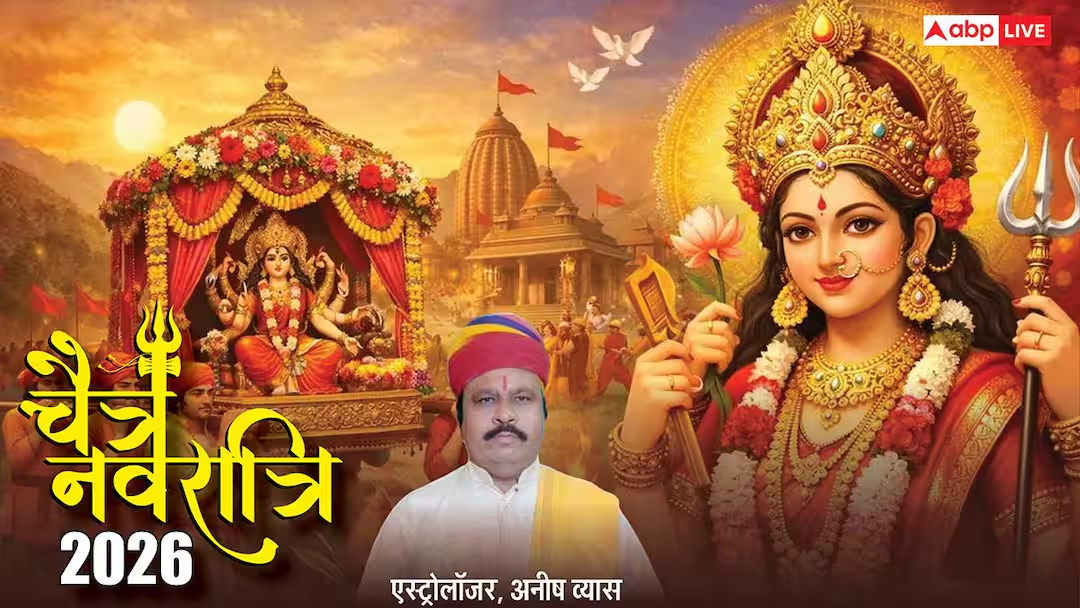
Chaitra Navratri 2026: Navratri is celebrated as a festival in India. The most popular is Shardiya Navratri, which is currently celebrated with great pomp throughout the country. Hardly anyone knows that there are 4 Navratris in a year. Every Navratri has different significance. It is said in Devi Purana that the festival of Navratri comes mainly twice in a year.
Why is Navratri called Nav-Ratri and not Nav-Din?
The word Navratri is made up of two words – Nav and Ratri. Nav means nine and the word Ratri again contains two words: Ra + Tri. Ra means night and Tri means three aspects of life – body, mind and soul. Three types of problems can surround a human being-
Physical, mental and spiritual. The one who provides relief from these problems is night. Ratri or night brings happiness in your life by liberating you from sorrow. Whatever be the condition of a person, everyone gets rest at night. Everyone puts aside their joys and sorrows and goes to sleep in the lap of night.
There is a rule to observe Navratri twice a year. In the month of Chaitra, from Pratipada of Shukla Paksha for nine days i.e. till Navami, and similarly, after exactly six months, the worship and accomplishment of Mata starts from Pratipada of Shukla Paksha till Navami. Among both the Navratras, Shardiya Navratras are given more importance.
Importance of performing Yagya in Navratri
- The process of Yagya and Havan continues during the nine days of Navratri. These yagyas remove all kinds of effects of sorrow and pain in the world.
- Every day of Navratri has its own importance and effect and yagyas and havans are performed according to that day. Both bad and good qualities influence us in life.
- Navratri teaches us how a person can overcome negativity with the basic goodness within him and can realize his supernatural nature. Just as an organism is formed only after nine months of growth in the mother's womb, similarly these nine days play an important role in taking us back to our original form, our roots. These nine days should be used for meditation, satsang, peace and attaining knowledge.
spring and autumn navratri
According to the Hindu calendar, Maa Durga is worshiped for 9 days on the first Navratri in Chaitra i.e. March-April, which is called Vasantiya Navratri. Navratri falling in the month of Ashwin i.e. September-October is called the main Navratri, which is known by the people as Shardiya Navratri. After Shardiya Navratri, festivals are celebrated all over the country. The festival of Dussehra is celebrated at the end of Sharadiya Navratri, which symbolizes the victory of righteousness over unrighteousness. Apart from this, 2 secret Navratri are also celebrated within a year which are not for householders. Both these Navratri fall in Ashadh i.e. June-July and the other in Magh i.e. January-February.
Shukla Paksha Pratipada tithi of Chaitra month will start at 6:52 am on March 19 and the tithi will end at 4:52 am on March 20. Therefore, this year Chaitra Navratri will start on March 19 with Ghatasthapana. According to Udaya Tithi, this year Chaitra Navratri will start from March 19 and will end on March 27.
The new Hindu year starts from Chaitra Navratri Pratipada date. Navratri is considered the best time to worship Goddess Durga in the form of Shakti. During these nine days, ceremonies and fasting are given priority over all other activities. Every evening, Goddess Durga is worshiped through religious dances like Dandiya and Garba. This festival of nine nights starts on the first date of Shukla Paksha of Ashwin month. During this period nine planets are consecrated.
During this, Durga Saptshati with 700 verses, also known as Devi Mahatmya, is recited, along with Durga Chalisa and various mantras and shlokas dedicated to the goddess, the goddesses who destroyed the evil ones are worshipped.
Yagya is performed on the eighth day of Navratri. Mahanavami: This colourful, energy-filled festival ends on Mahanavami. Kanya Puja is performed on this day. Nine virgin girls are fed. These nine girls are worshiped as nine forms of the mother. Nav literally means nine and it is also called Nav i.e. new.
There is a rule of fasting for nine days during these days. In fact, during this period, the fasting person makes himself powerful from within by eating balanced and sattvik food and devoting his attention to contemplation and meditation.
This not only gives him good health but he also strengthens himself internally to bear the change in weather. Nine forms of Mother Goddess are worshiped during Navratri. We can understand these nine forms of Mother through the worship of various forms of the Goddess and her pilgrimages.
During this period, bhajan-kirtan etc. are organized in every house. Shardiya Navratri is celebrated as Durga Puja in Eastern India and Dandiya in Western India.
Importance of 9 nights of Navratri
The word Navratri means 'nine new nights (special nights)'. At this time, new forms of Shakti are worshiped because the word 'Night' is considered a symbol of accomplishment. The ancient sages of India have given more importance to night than day. This is the reason why there is a tradition of celebrating festivals like Diwali, Holika, Shivratri and Navratri etc. at night. If there was no special mystery of the night, then such festivals would have been called day instead of night. Like Navdin or Shivdin. But we don't say that.
During Navratri, a community of devotees gather at 51 Shakti Peethas with great enthusiasm to worship Shakti and those worshipers who are unable to reach these Shakti Peethas, invoke Shakti at their residence itself. However, nowadays most of the worshipers perform Shakti Puja not at night but by calling the priest during the day.
Not only the common devotees but even the Pandits and Sadhu-Mahatmas now do not want to stay awake the whole night during Navratri nor does anyone want to give up laziness. Nowadays, very few worshipers are seen abandoning laziness and using night time to attain soul power, mental strength and yogic power. Whereas the sages tried to understand and explain the importance of night very minutely from a scientific perspective.
Now it is also a universally accepted scientific fact that many obstacles of nature disappear at night. Our sages and sages had already known these scientific secrets of nature thousands and millions of years ago. If you pay attention, you will find that if the sound is given during the day, it does not travel far, but if the sound is given at night, it goes very far.
Apart from the noise of the day, there is also a scientific fact behind this that the sun's rays during the day stop the sound waves and radio waves from moving forward. Radio is a living example of this. You yourself must have realized that it is difficult to catch or listen to low power radio stations during the day, whereas after sunset even the smallest radio station can be heard easily.
Its scientific principle is that just as the sun's rays block radio waves during the day, similarly the thought waves of chanting mantras are also blocked during the day. That is why the sages have said that the importance of night is much greater than that of day.
Due to the vibrations of the bells and the sound of the conch in the temples, the environment becomes free from germs far and wide. This is the logical mystery of the night. Keeping this scientific fact in mind, those who send their powerful thought waves into the atmosphere with determination and high concept at night, their work i.e. the fulfillment of their wish is definitely achieved if they do it at the right time and according to the right method as per their auspicious resolution.
Scientific basis behind Navratri This means that during the Earth's revolution around the Sun, there are four sandhis of a year, out of which the two main Navratri of the year fall in the round sandhis falling in the months of March and September. At this time, there is the highest possibility of germ attack.
Physical diseases often increase during seasonal changes. Therefore, the name of the process done at that time to remain healthy and to keep the body pure and to keep the body and mind pure and completely healthy is 'Navratri'. Should nine days or nine nights be counted in Navratri? The name 'Navratri' is meaningful as the fasting rule continues from the night of Amavasya to Ashtami or from Padwa to the afternoon of Navami for nine nights. Since nights are counted here, it is called Navratri i.e. a group of nine nights.
Best time to control senses
Through metaphor, our body has been said to have nine main doors and the life force residing within it is named Durga Devi. As a symbol of establishing discipline, cleanliness and harmony in these main senses, the festival of purification of nine gates is celebrated for nine days to keep the body system functioning smoothly for the whole year. To give them personal importance, nine days are said for nine Durgas.
Although, to keep the body smooth, we do catharsis, cleaning or purification every day, but to completely clean the body parts internally, a cleanliness campaign is conducted at an interval of every 6 months, in which following the fast of Satvik diet purifies the body, pure intellect in a clean body, good deeds come from good thoughts, good character comes from deeds and respectively, the mind becomes pure, because only in the temple of a clean mind is the permanent abode of the power of God. Is.
Nav means nine and the word Ratri again contains two words: Ra + Tri. Ra means night and Tri means three aspects of life – body, mind and soul. Three types of problems can surround a human being – physical, mental and spiritual. The one who provides relief from these problems is night. Ratri or night brings happiness in your life by liberating you from sorrow. Whatever be the condition of a person, everyone gets rest at night. In the lap of night everyone puts aside their joys and sorrows and goes to sleep.
The process of Yagya and Havan continues during the nine days of Navratri. These yagyas remove all kinds of effects of sorrow and pain in the world. Every day of Navratri has its own importance and effect and yagyas and havans are performed according to that day. Both bad and good qualities influence us in life.
Navratri teaches us how a person can overcome negativity with the basic goodness within him and can realize his supernatural nature. Just as an organism is formed only after nine months of growth in the mother's womb, similarly these nine days play an important role in taking us back to our original form, our roots. These nine days should be used for meditation, satsang, peace and attaining knowledge.
Panchang 19 March 2026: See Chaitra Navratri Ghatasthapana Muhurta, Rahukaal time, Yoga and complete Panchang.
Disclaimer: The information provided here is based only on assumptions and information. It is important to mention here that ABPLive.com Does not constitute any endorsement or verification of information. Before implementing any information or belief, consult the concerned expert.