What do the rules say about what Avesh Khan did in the match against Hyderabad?
Last Updated:
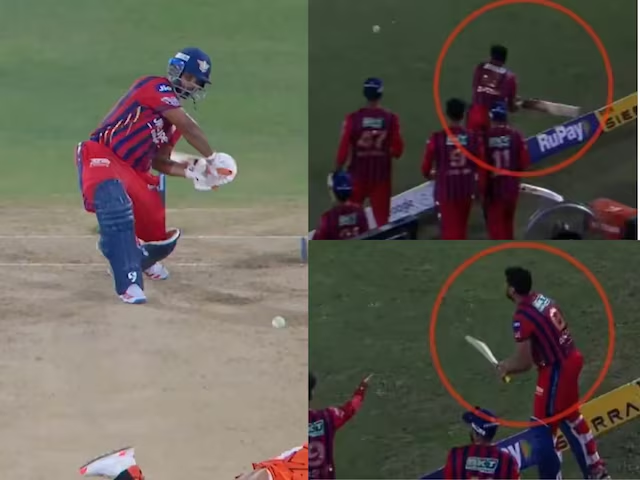
avesh khan controversy explained: Rishabh Pant hit the winning four, on which Avesh Khan, standing in the dugout, hit it inside the ground with his bat even before the ball crossed the boundary. This action of Avesh has created a new controversy. It is being said on social media that the umpire should have given it a ‘dead ball’ or a penalty of 5 runs. Lucknow Super Giants won this match by 5 wickets.
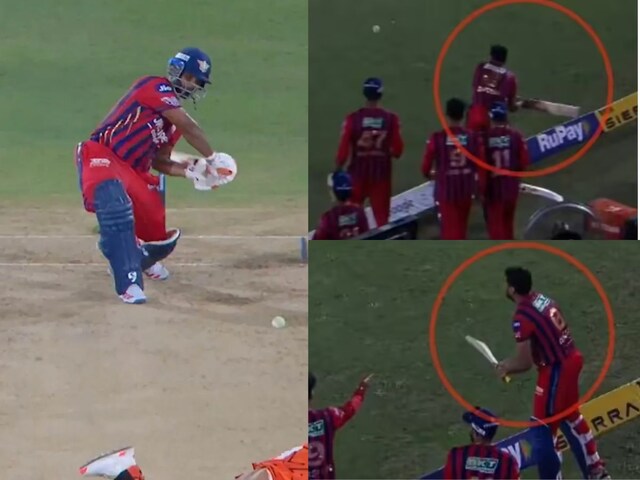

Uproar over Avesh Khan blocking boundaries.
New Delhi. A new controversy has arisen due to an action of Avesh Khan in the match between Lucknow Super Giants and Sunrisers Hyderabad on Sunday (April 5). Actually, this happened during the last over when Lucknow Super Giants needed one run to win and Lucknow captain Rishabh Pant was on strike. Rishabh Pant hit the winning four on Jaydev Unadkat’s ball, but before the ball crossed the boundary, Avesh Khan, standing near the dugout wearing pads in celebration of victory, hit him back towards the field with the bat. Controversy arose regarding just this.
Why is there ruckus?
This action of Avesh Khan is being called a violation of rules on social media. At the same time, some people say that 5 runs should have been given as penalty. Some are also saying that it should have been declared a dead ball. Let us understand this entire matter calmly. We will also tell you what the rules say about what Avesh Khan did.
Uproar over Avesh Khan blocking boundaries.
What do the rules say?
Former international umpire Anil Chaudhary has made a video regarding this entire matter, in which he has told whether Avesh Khan has really violated the rules. Anil Chaudhary says, ‘Avesh Khan threw the bat while celebrating early, it is his habit, earlier in a match against RCB, he had thrown his helmet after winning, after which he was fined. They should take some care about this thing. He further said, ‘There is no point in giving a penalty of 5 runs, because there was no fielder nearby and neither did the fielding team suffer any kind of loss.’
Why no penalty?
Anil Chaudhary explains by giving the example of another match, in which the fielder is near the ball, but the ballpicker present there picks up the ball before it hits the boundary rope. In this case, the umpire gave only two runs to the batting team instead of four, because the fielder was nearby. Anil Chaudhary said, ‘This was not the case in Avesh Khan’s case. If he had hit the bat like this in the middle of the match, the batsman could have been taken into the Damaging the ball category, but here the penalty of 5 runs has no meaning. He further said, ‘This is a very rare scenario, which people are looking for in the book.’
View this post on Instagram