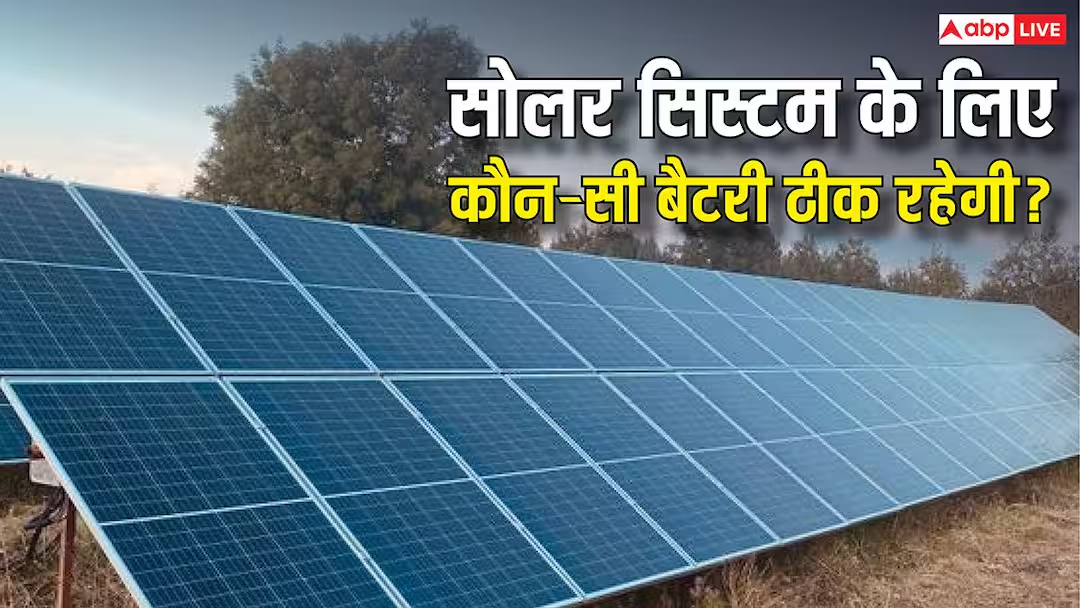
- Lithium-ion and lead-acid battery options for solar systems.
- Lithium-ion is expensive, while lead-acid is available cheaper.
- Lithium-ion charges faster, lasts longer and requires less maintenance.
- Overall, lithium-ion is a better choice for solar systems.
Best Solar Battery: If you do not want to depend on the grid for your home’s electricity needs, then hybrid or off-grid solar system can be useful for you. With the right battery it will make you energy independent. In such a situation, the question arises that which battery should be used for the solar system installed at home. If we look at the current options in the market, there is competition between Lithium-ion and Lead-acid batteries. Today we are going to tell you how both types of batteries work and which of them costs less and has more benefits.
How do Lithium-ion batteries work?
Lithium-ion batteries contain lithium components such as lithium iron phosphate and nickel manganese cobalt at the cathode, while graphite is present at the anode. It stores energy using fast moving lithium ions. When electricity is generated from the solar panel, lithium ions move from the positive plate to the negative plate. When it uses the stored energy, the ions come back from the negative plate to the positive plate.
How does a lead-acid battery work?
If we talk about lead-acid battery, both positive and negative are lead plates, which are kept between sulfuric acid, which acts as electrolyte. When the battery is charged, a reaction occurs between the lead plates and the acid. When this battery is discharged, this reaction reverses.
Which of the two costs less?
In terms of price, lithium-ion batteries are expensive. If we look at it in terms of kWh, the price of Lithium-ion battery is around Rs 15,000-20,000 per kWh. In comparison, lead-acid batteries will be available for around Rs 8,000-12,000 per kWh. Now the question arises whether lead-acid battery is the right option due to its low price? The answer is that if you are only looking at the upfront price then this battery is right for you, but it also has many disadvantages.
Who has more benefits?
Even though the initial cost of lithium-ion battery is high, its benefits cannot be ignored. Lithium-ion batteries charge faster than lead batteries and also have a longer life. While lead batteries last for 3-5 years, lithium batteries last for more than 10 years. Similarly, lithium battery is smaller in size and lighter in weight than lead battery. Lead batteries require frequent maintenance and lithium batteries do not have this hassle. Lithium battery can be monitored only through Bluetooth. Seen this way, lithium-ion battery is a better option for solar system.
Read this also-
Should AC be used in rain? Know the right way to use AC in monsoon