Last Updated:
5 Smallest margin of victory by runs in Test: In the 149-year history of Test cricket, when the five-day struggle comes down to a margin of just one run, then all limits of excitement are broken. From West Indies' victory in Adelaide in 1993 to New Zealand's historic comeback in 2023, the sports world has seen 5 such short and breath-taking victories that made the giants sweat.
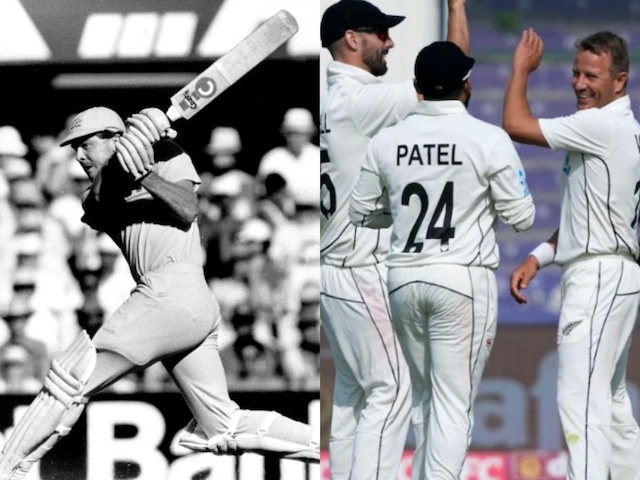

Five smallest wins in test history.
New Delhi. Hundreds of matches have been played in the 149-year history of Test cricket, but there are some matches which go beyond the win-loss statistics and become 'immortal'. When five days of play, four innings and the entire strength of the players comes down to the difference of just A or D runs, then understand that cricket is in its most brutal and most exciting form. This is considered to be the most prestigious match in the history of Test cricket. In 1993, West Indies had given Australia a target of 186 runs to win on Adelaide grounds. At one time the Australian team was struggling, losing 8 wickets for 102 runs, but Tim May and Craig McDermott did not give up. In the last moments of the match, Australia needed only 2 runs to win and they had only 1 wicket left. A rising ball from Courtney Walsh touched McDermott's gloves and went to the keeper and West Indies won by 1 run. This was the first such victory in Test history where the difference was only 1 run.
History repeated itself after almost 30 years in the year 2023. The England team was feeding follow-on to New Zealand in its aggressive 'baseball' style. No one thought that the team playing follow-on could win the match. New Zealand set a target of 258 runs for England. In the last innings of the match, Neil Wagner trapped the match by dismissing legends like Joe Root and Ben Stokes. In the end, as the wicket of James Anderson fell, New Zealand registered a historic victory by 1 run. It became only the fourth team in Test history to win the match after playing follow-on.
Five smallest wins in test history.
The Ashes series is called 'the biggest series of the century'
The Ashes series of 2005 is called the 'biggest series of the century'. In this match played at Edgbaston, England gave Australia a difficult target of 282 runs. Shane Warne and Brett Lee dragged the match till the last over. When Australia needed only 3 runs to win, Michael Kasprowicz was out on a bouncer from Steve Harmison. Umpire Billy Bowden's raised finger and Andrew Flintoff consoling Brett Lee is still one of the most memorable pictures of cricket. England won this match by 2 runs.
When teams could not cross the 3-run wall
There are two big examples of victory by 3 runs in Test history. In 1902, this was the period in Manchester when pitches were not covered. Australia had given England a target of only 124 runs, but the entire England team was limited to 120 runs. Australia won by 3 runs. After this, in 1982, England set a target of 292 runs for Australia in Melbourne. Jeff Thomson and Allan Border put Australia on the verge of victory by adding 70 runs for the last wicket, but in the end England snatched the victory by 3 runs.
thin line of victory and defeat
Seeing these matches it is clear why Test cricket is called 'real cricket'. When the result comes out by 1 run after 5 days of hard work, then it is a test of the character of the players. Be it Courtney Walsh's spell in 1993 or Neil Wagner's bowling in 2023, these records show that in cricket, anything is possible until the last ball is bowled.
About the Author

Active in journalism for about 15 years. Studied from Delhi University. Interested in sports especially cricket, badminton, boxing and wrestling. Covered IPL, Commonwealth Games and Pro Wrestling League events. From February 2022…read more