Anti Paper Leak Bill: Paper leak in the country is no longer just an examination problem, but every year it has become a question related to the future of lakhs of students and the credibility of the government. Central government in Lok Sabha regarding this Public Examination Prevention of Unfair Means Amendment Bill 2026 Has brought. This bill makes changes to the law of 2024 which is called Anti Paper Leak Act. In this explainer, we will understand the complete technical information about the Paper Leak Bill and the reason behind it, as well as the environment around it, in simple language.
First of all, what is this bill?
This is not a completely new law, but an amendment to the old law. The basic law is the Public Examination Prevention of Unfair Means Act 2024. This was the first national law in the country that directly dealt with paper leaks and organized irregularities in examinations. The 2026 bill makes both the punishment and procedure of this law more stringent. According to the government, mainly seven major changes have been made in this bill.
What was there in the old law i.e. Act of 2024?
The Act of 2024 was passed by the Parliament in February 2024 and came into force in the entire country from 21 June 2024. This law applies to the examinations of the Central Government and its agencies. These include examinations like UPSC, SSC, Railway Recruitment Board, National Testing Agency i.e. NTA and banking recruitment. One thing is very clear in this law that its target is not the students, that is, the candidates appearing for the examination do not come under its purview. Its target is those gangs, service provider companies and those officials who leak papers or commit irregularities in collusion.
What changed regarding punishment in the new bill?
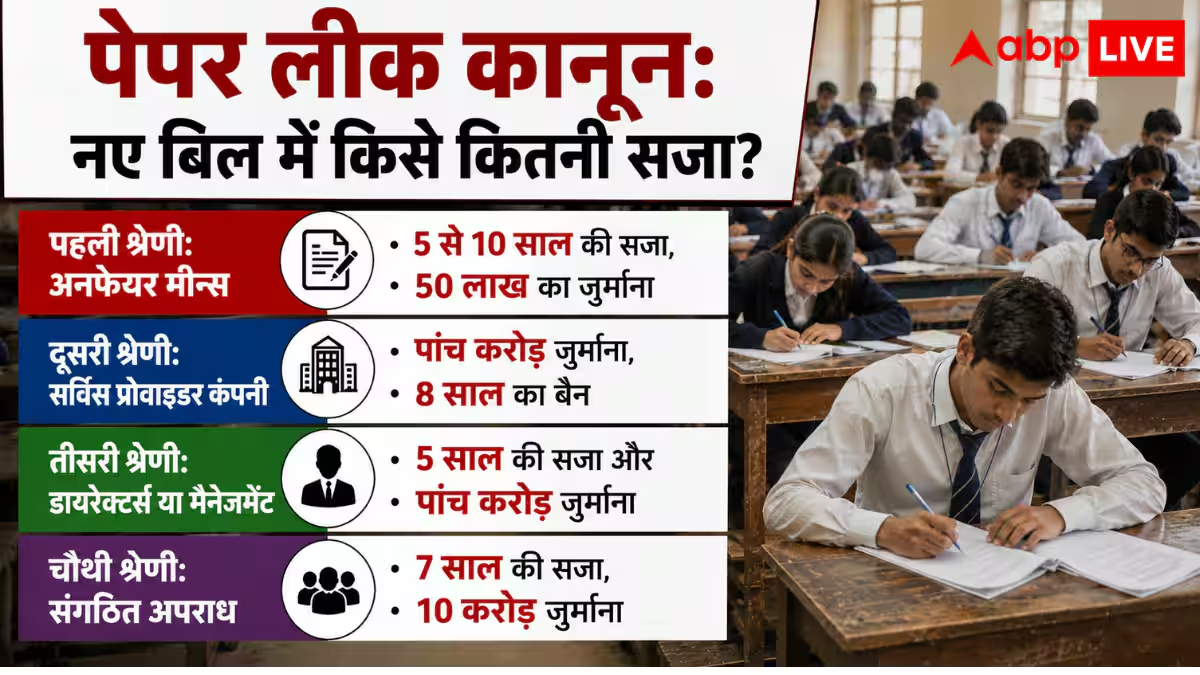
This is the biggest part of this amendment. Punishment and fine have been increased in every category.
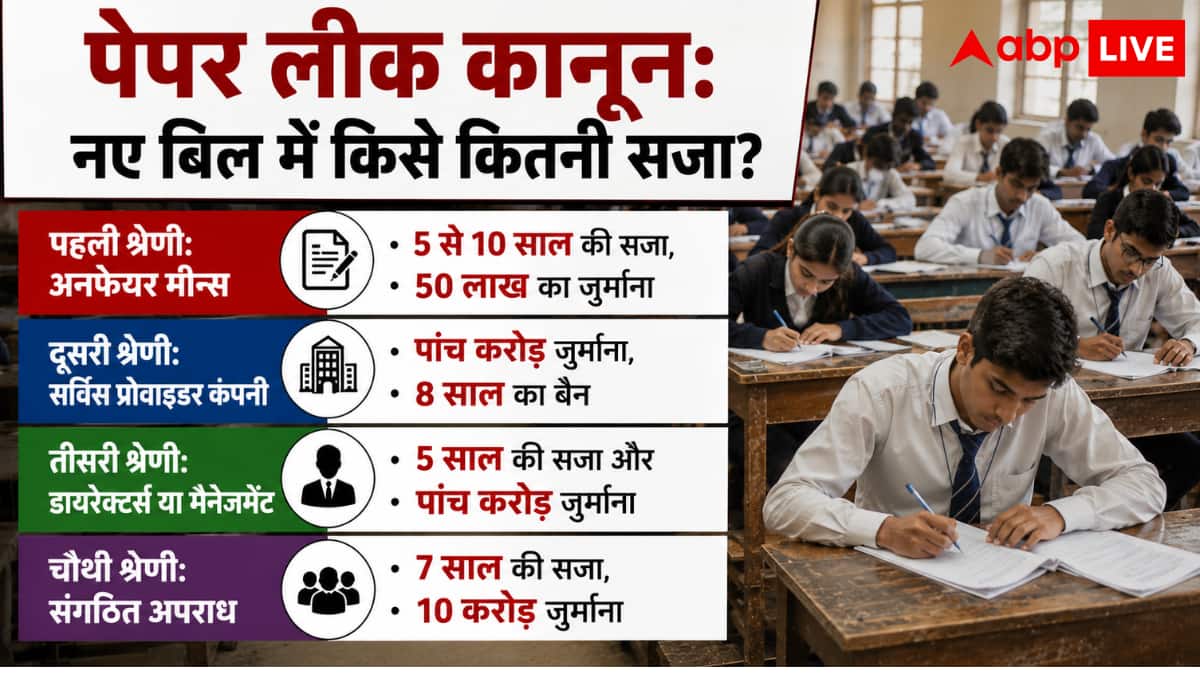
- The first category is of common unfair means. According to the bill, till now there was a provision of three to five years in jail and a fine of up to Rs 10 lakh. In the new bill, it has been increased to five to ten years of jail and a fine of up to Rs 50 lakh.
- The second category is of the service provider company conducting the examination. Earlier, a fine of up to Rs 1 crore was imposed and he could be kept out of examination related work for four years. Now the fine has been increased to Rs 5 crore and the ban period has been increased to eight years.
- The third category is of those directors or management with whose collusion the leak occurs. Earlier, there was a minimum jail term of three years and a fine of Rs 1 crore. Now the minimum punishment has been reduced to five years and fine to Rs 5 crore.
- The most stringent provision is on organized crime. Earlier, there was a minimum jail term of five years and maximum ten years and the fine was at least Rs 1 crore. In the new bill, the minimum punishment has been increased to seven years and the fine has been increased to a minimum of Rs 10 crore.
What is new in the system of investigation and trial?
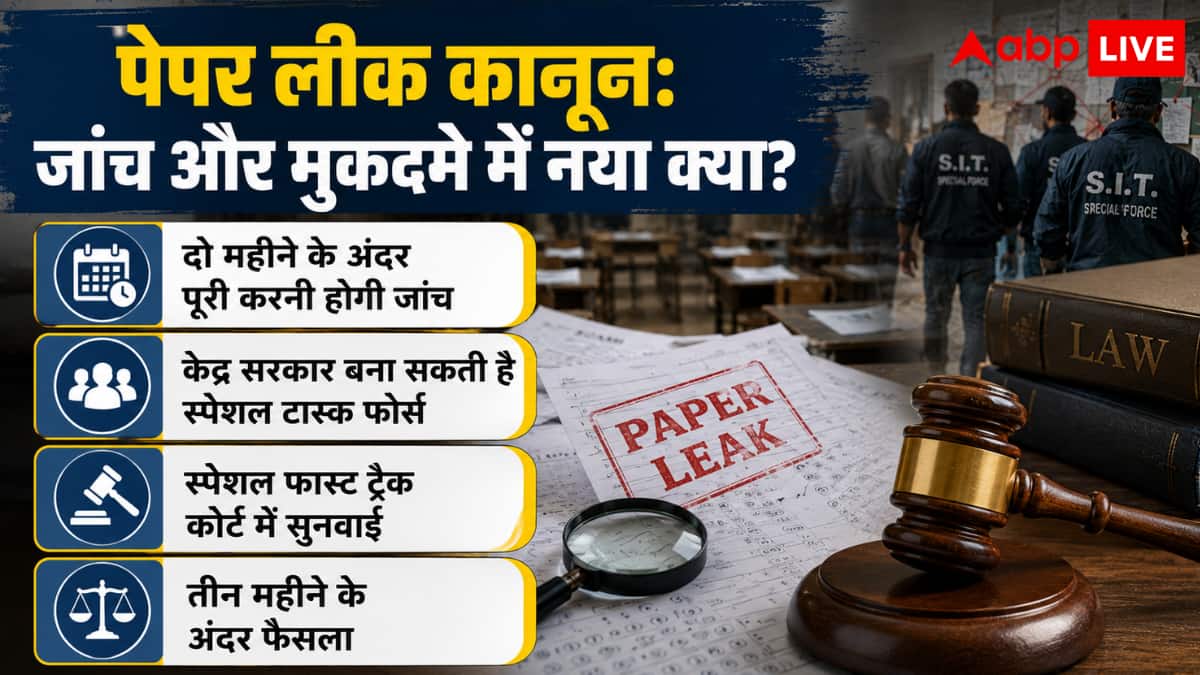
Merely increasing the punishment was not considered enough, hence a major change has also been made in the bill on the speed of investigation and trial. For this, two new sections 12A and 12B have been added to the law. According to the bill, now the investigation of every case will have to be completed within two months. The Central Government has been given the right to form a special task force for investigation if necessary and if a task force is formed then only it will conduct the investigation.
There is a provision to set up a special fast track court for hearing. Every state and union territory will have to designate a sessions court as such fast track court in consultation with the Chief Justice of the High Court. The trial will continue in this court on a daily basis and the trial will have to be completed within three months of the filing of the charge sheet. The old cases which are already pending will also be sent to this court and they will also have to be disposed of within three months of their receipt. Apart from this, a separate special public prosecutor i.e. government lawyer will be appointed for every fast track court.
New avenue of appeal
There is also a clear provision regarding appeal in the bill, which was not there earlier. According to the new section 12B, any decision or punishment of the fast track court can be appealed directly to the High Court. A bench of two judges of the High Court will hear this appeal and will try to settle it within three months. The appeal will have to be made within thirty days and if there are valid reasons, the High Court can extend it up to ninety days but after that the appeal will not be heard. The route of appeal has also been kept in the High Court against the order of granting or not granting bail.
Why did you have to bring all this?
Now the real question is that when the 2024 law already existed then why was there a need for a new bill? The answer lies in the situation of the last two years. Despite strict laws, there were reports of irregularities and leaks in major examinations. According to reports, more than twenty-two lakh candidates were affected by the alleged NEET UG 2026 paper leak and ultimately the exam had to be cancelled. Along with this, questions were also raised regarding CBSE’s on-screen marking. These incidents created a huge movement of students across the country.
The government itself has admitted in the objectives of the bill that in the present system the cases dragged on for years and there was no separate court for speedy trial. This is the reason why a system of time bound investigation, fast track court and appeal has been brought in the new bill. The government’s argument is that if the trial is speedy along with strict punishment, it will create real fear among the criminals.
The surrounding picture means how big is the matter?
Paper leak is not a new or isolated problem. Not only the Centre, many states have also brought strict laws at their level. For example, Uttar Pradesh, in its paper leak law, has made a provision for punishment up to life imprisonment and a fine of up to Rs 1 crore for the culprits. From this it is understood that the problem of leakage is of the entire country and its network is often spread in many states simultaneously. This is the reason why the Center has been presenting its law as a model so that states can also adopt it.
Understand the environment of Parliament and politics
The political environment around this bill is as important as the bill itself. According to reports, this bill has come in the monsoon session of Parliament at a time when there was an uproar over the paper leak since the beginning of the session. Along with the bill, the opposition is also protesting against the alleged police action against the students’ protest on July 20. The ruling party has fielded many young MPs for the debate.
Also read: Registration for CAT 2026 will start from August 3, exam on November 29
Mood of students and experts
The mood from the students’ side is clear that they want accountability and a reliable system. Due to repeated leaks, there is both anger and disappointment among the hardworking students because years of preparation goes waste due to one leak. This feeling is visible from the streets to the Parliament.
The opinion of experts is a bit cautious. He believes that no matter how strict the law is on paper, the real test lies in its implementation. Even in the 2024 law, there was a jail sentence of up to ten years and a fine of crores, yet leaks continued. Therefore the question is how much difference will just increasing the figures make. Experts say that the leak actually occurs during the printing, transportation and maintenance of the paper or from the network of coaching mafia. Unless the security, cyber monitoring and technical audit of this entire process is strengthened, punishment alone will not stop the leak.
Will the exam become leak-proof now?
The direct answer to this is not yes or no. On one hand, the government’s argument is strong that a fine of Rs 10 crore, ten years of jail and the pressure of completing the trial in three months is a big threat to the mafia. On the other hand, it is also true that punishment comes after the crime whereas the real challenge is to stop the leak in the first place. Therefore, it would be correct to say that the new law strengthens the fight against leaks but it alone cannot be called leak-proof.
What to look forward to?
The real test of this bill will begin after it is passed. It has to be seen how quickly the states create fast track courts, how many cases are actually decided in these courts within three months and how many culprits are punished. If the investigation and trial is really speeded up and in some big cases, punishment is given quickly, then its effect will be visible, but if the system remains as slow as before, then the stringent provisions will remain only on paper. Besides, it will be equally important to make the entire examination process safe with technology and strict monitoring.
Also read: NEET UG counseling schedule will be released soon, check from here
Education Loan Information:
Calculate Education Loan EMI