Last Updated:
This fearless left-handed opener, who won the Orange Cap by scoring 776 runs in IPL 2026, was accompanied by tremendous form and records. Despite this, he had to sit out, which has given rise to a big debate on the criteria for selection of the playing eleven in the Indian team.
How is the playing XI selected, whose vote is more important among the coach and captain?
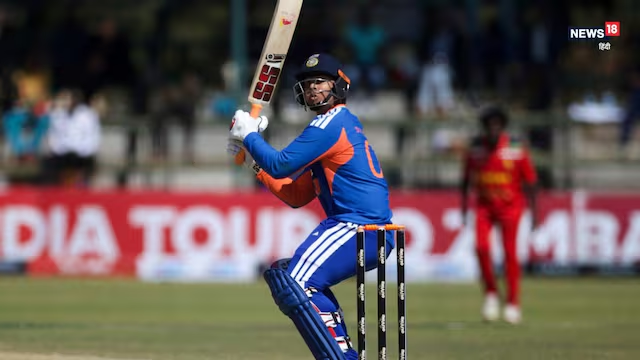
New Delhi. When 15-year-old young sensation Vaibhav Suryavanshi did not get a place in the playing eleven in the first match of the T20 series against Ireland in Belfast, it became a big topic of curiosity and debate among cricket fans. This fearless left-handed opener, who won the Orange Cap by scoring 776 runs in IPL 2026, was accompanied by tremendous form and records. Despite this, he had to sit out, which has given rise to a big debate on the criteria for selection of the playing eleven in the Indian team.
When the playing eleven is selected on foreign tours, as a cricket journalist, your first guess is from the cardboard in the coach’s hand on which the batting order of the nets is written and then you guess which player in the nets seems to be in better mood and match fit than the rest of his teammates. Now the team management can give different reasons for not playing Vaibhav, but one thing is clear that while choosing the playing eleven, three things are definitely kept in mind.
The Scale of Form: When the Scales of Seniority Tipped Heavy
The most basic rule of cricket says that the player who is in best form should get a chance immediately. Vaibhav Suryavanshi meets this scale 100%. He not only opened the bowling lines in IPL 2026, but recently played a stormy innings of 94 runs in 29 balls for India A in Sri Lanka by scoring the fastest List-A half century in just 11 balls. But the dilemma in front of the team management was that the team already has established openers like Sanju Samson, Abhishek Sharma and Ishan Kishan, who are continuously scoring runs. Batting coach Sitanshu Kotak had clearly said before the match that Vaibhav is exceptionally talented, but it would be unfair to him to drop the consistently performing senior players just to give a chance to someone else. Here the criteria for selection became ‘respect for the performance of senior players’ rather than ‘just current form’.
2. Touch and preparation time at the nets: Effect of one day’s practice
The second big parameter is what kind of touch or rhythm the player is seen in the nets just before the match. Due to the weather conditions and some hiccups in Belfast, the Indian team got a chance to practice only for one day before the match. When preparation time is so short, coaches and captains often rely on players who are accustomed to international conditions and have previous experience handling pressure. 15-year-old Vaibhav has no shortage of talent, but playing him directly in a match without adequate net practice in foreign and seaming conditions could have been risky for his confidence. The management thought it better to give him some more time to adjust to the environment.
3. Choice of coach and captain: Team vision and balance
The most decisive parameter for choosing the playing eleven is the strategy and choice of coach Gautam Gambhir and new captain Shreyas Iyer. Gambhir always emphasizes on a team balance where the role of each player is very clear. The team had the challenge of maintaining the winning combination that won the World Cup or trying back-up openers. Right after Ireland, India has to play a tough T20 series against England. In such a situation, the captain and coach wanted to keep the senior batsmen in rhythm so that the team’s momentum does not deteriorate on big tours.
It is natural for the fans to be disappointed with Vaibhav not playing because everyone wanted to see this ‘Wonder Boy’ breaking Sachin Tendulkar’s 36-year-old record and becoming India’s youngest international cricketer, but this decision of the team management is not a doubt on Vaibhav’s ability, but a thoughtful process to manage his career. As pointed out by the coaching staff, Vaibhav Suryavanshi is the future of Indian cricket, and he will definitely get his share of opportunities at the right time.
About the Author

I, Rajeev Mishra, am currently working as Associate Sports Editor at Network 18. In this role, I am responsible for digital sports content planning, editorial strategy and anchoring. Sports magazine…read more