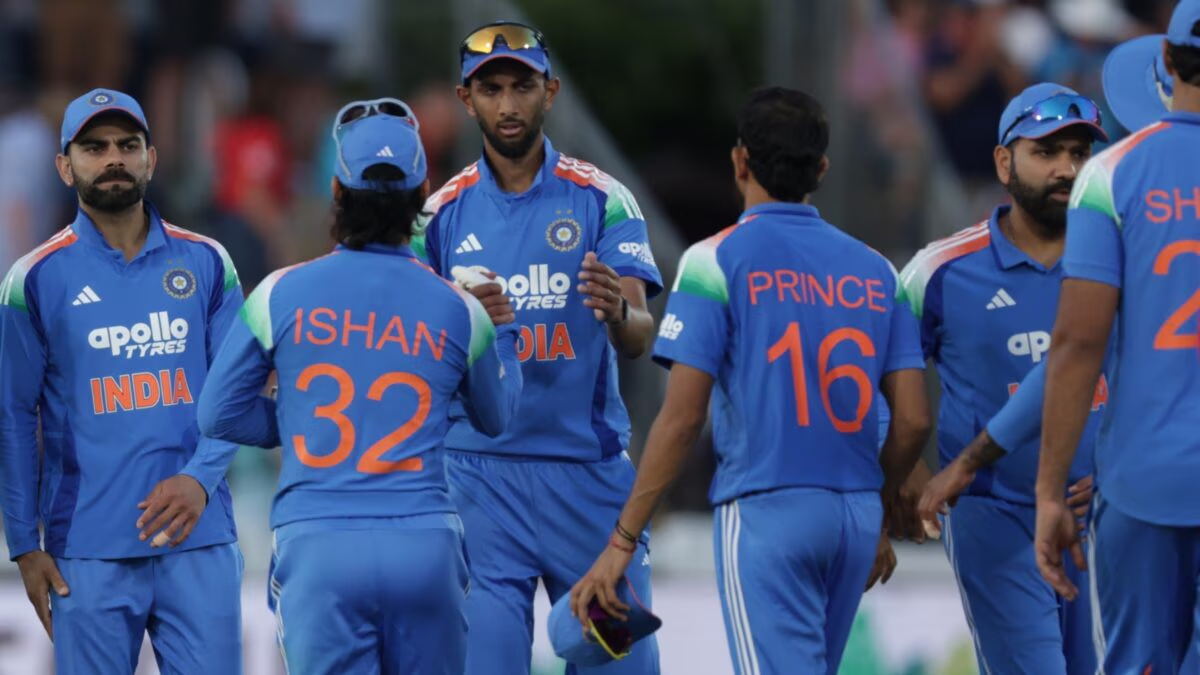
New Delhi. When a match is decided in just 18 balls, then both the uncertainty and cruelty of cricket become understandable simultaneously. Team India was very close to victory in the third ODI against England, but the last three overs turned the tables. The match was in the Indian grasp till the 45th over, but what happened on the field after that broke the hearts of crores of fans. India’s young and inexperienced bowling attack, the famous trio of Krishna, Prince Yadav and Gurnoor Brar gave away 62 runs in the last 3 overs. This was the turning point which gave England an unimaginable victory by 27 runs and India lost not only the match but also the entire ODI series. After the match, disappointment was clear on the face of captain Shubman Gill, and he blamed the entire defeat on the directionless bowling in the death overs.
There was a time in the match when the Indian team was completely in the driving seat. England’s batsmen were struggling to score runs and the Indian spinners were tight in the middle overs. Captain Shubman Gill also accepted this in the press conference after the match. Gill said, ‘We were completely in the match till the 45th over. Everything was going well as per our plan, but the last three overs took the match away from us. Actually, the strategy of the Indian team was very clear that the match should be dragged till the last overs and the opposition team should be restricted to within 300. When the wicket slowed down after the 40th over, wisdom was expected from the bowlers, but the young pace attack completely failed to withstand the pressure.
Turning point of India-England third ODI.
Prasidh, Prince and Gurnoor gave away 62 runs in 3 overs.
The real drama of the match and the script of Indian team’s defeat started being written from the 46th over. England’s batsmen, who had settled on the crease, took full advantage of the inexperience of the Indian fast bowlers. Experienced Prasidh Krishna, who was returning after injury, was expected to bowl yorkers and slower balls in the death overs, but his balls neither showed any edge nor accurate direction.
Young Prince Yadav had bowled well in the beginning, but in the last overs the England batsmen counter-attacked him, to which Prince had no answer.
Directionless bowling of Gurnoor Brar
Gurnoor impressed with his pace, but when full tosses and length balls started hitting boundaries, he completely lost control. These three bowlers together gave 62 runs in the last 18 balls. This combination of full toss, wide and length balls took England to a score which put mental pressure on the Indian batsmen.
Rohit Sharma’s fighting century went in vain
It was not easy for the Indian team, which came out to chase this big target, to score runs, because the wicket was continuously slowing down. In such difficult times, experienced Rohit Sharma once again took charge. Rohit played an excellent century on a slow and turning pitch and proved why he is considered the most dangerous ODI batsman in the world.
Captain Gill praised Rohit and Virat Kohli and said, ‘Rohit bhai batted brilliantly. It was not at all easy to score strokes on this wicket, but the way he handled the innings was amazing. Rohit and Virat have proved themselves in different parts of the world over the years. However, this brilliant century of Rohit was ruined by the failure of the bowlers in those 18 balls.
Where else is the run chase strategy lacking?
Shubman Gill also talked about the run chase strategy of the Indian team. He told that after the powerplay, the Indian team was progressing at the rate of 6 to 6.5 runs per over. The team’s plan was to win the match by scoring runs at a run rate of 10 runs per over in the last 10 overs, provided there were wickets left in hand. But when the bowlers gave away 62 extra runs in the death overs, the required run rate suddenly skyrocketed. It was impossible to hit boundaries on every ball in the last overs on a slow pitch, and this became the biggest reason for India’s defeat.