New Delhi. The history of cricket is not made only of stories of runs and fours and sixes. Its real foundation has been laid by those bowlers, who for decades made the batsmen dance with the magic of their fingers and the precision of their wrists. If we delve deeper into the statistics of first-class cricket, we find five such fearsome bowlers who changed the definition of bowling. These five names are not just figures, but they are the pride of an era.
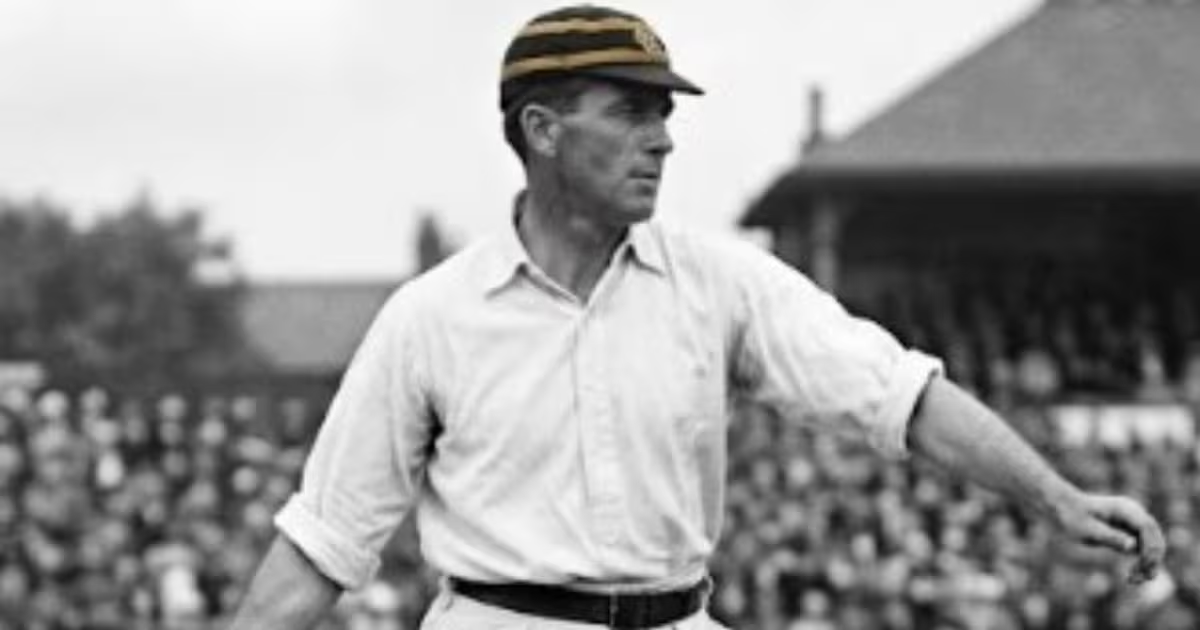
This story starts with the name Wilfred Rhodes, who broke all the records of bowling. From 1898 to 1930, i.e. for 32 years, Rhodes made the cricket ground his workplace. He played a total of 1110 matches, which is an incredible record in itself. During these matches, he bowled 1,85,742 balls and took a total of 4204 wickets at the cost of 70,322 runs. His performance was so lethal that he took wickets at an average of 16.72. When we think of Rhodes, we must imagine a player who showed the courage to take the field 1110 times. His 4204 wickets are still a peak in first-class cricket, which now seems impossible to touch.
Spinner Wilfred Rhodes has 4204 wickets in his name.
Freeman established his dominance even in less matches
After this comes a name which is known for its lethal ability, AP. Freeman (AP Freeman). Freeman, who was active between 1914 and 1936, established his dominance even in fewer matches. He took 3776 wickets in 592 matches. Freeman’s specialty was his consistency. He bowled 1,54,658 balls and also achieved the feat of taking 10 wickets in an innings (10/53). This shows how a bowler can single-handedly change the course of a match. His average was 18.42 and strike rate was 40.9, which makes him a dreaded hunter according to that era.
Cwl. Parker took 3278 wickets with the art of spin.
The next name in this list is CWL. Parker (CWL Parker), who demonstrated his spin art between 1903 and 1935. Parker took 3278 wickets in his career of 635 matches. He bowled approximately 1,57,059 balls. Parker’s best performance of 10/79 still speaks of the accuracy of the bowlers of that era. He was a symbol of consistency, who broke the back of batting with an average of 19.46.
JT. Hearn has 3061 wickets in his name
JT, who played cricket between 1888 and 1923. JT Hearne was one of the early legends who set the standards of bowling. Taking 3061 wickets in 639 matches was no small achievement. He bowled 1,44,470 balls. Hearn’s best performance of 9/32 is a testament to how lethal he proved to be for the opposition team. With an average of 17.75, Hearn proved that he was one of the most economical and effective bowlers of that era.
Goddard took 2979 wickets in 593 matches.
We are TWJ. How can one forget TWJ Goddard, who left his mark from 1922 to 1952. Goddard took 2979 wickets in 593 matches. He faced the batsmen with 1,42,211 balls and also gave an excellent spell of 10/113. His career was part of a period of change in cricket, where the game became more competitive. With an average of 19.84, Goddard was a bowler on whom the captain could always rely. The story of these five greats is not just about counting wickets. This is the story of that period when cricket was considered not just entertainment but an art.
These bowlers collectively bowled millions of balls, spent thousands of days in the sun and proved their fitness and skills in such a way that they are an inspiration for today’s players. When we look at modern cricket today, these figures remind us that today’s cricket is so prosperous because of the foundation laid by these players. These five players are immortal pillars of first-class cricket, the echo of whose bowling is still heard in the corridors of cricket.