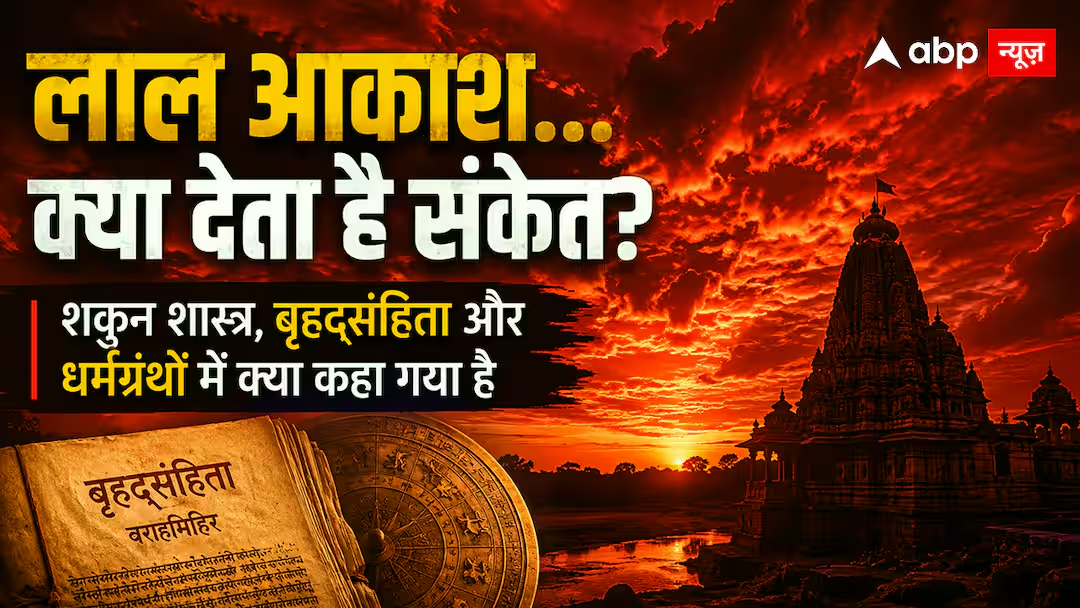
Red Sky Meaning: Recently, the sky appeared dark red at sunset in Caracas, the capital of Venezuela. As soon as the pictures of this amazing and rare scene went viral on social media, it became a topic of discussion all over the world. While science considers it to be the result of special atmospheric conditions i.e. scattering of light, such unusual natural scenes have deep significance in Indian reality and Manisha.
In ancient texts, divination traditions and astrological codes, this red form of the sky has been seen as ‘Utpat’ i.e. extraordinary signs given by nature. Let us understand on the basis of the most authentic sources of Indian knowledge tradition. What could be the meaning of this scene?
The sky over Caracas, Venezuela, turned reddish at sunset this evening. pic.twitter.com/ATrSiXMGPE
— Weather Monitor (@WeatherMonitors) July 1, 2026
After all, why was the red sky called ‘terror’ in the ancient codes?
In the Indian knowledge tradition, any event that deviates from the normal laws of nature has been placed in the category of ‘Natural Phenomena or Portents’. Sages like Maharishi Gargya and Parashar have given detailed classification of celestial, cosmic and terrestrial changes.
Ancient masters believed that whatever happens in the universe is directly related to the life on earth. When the sky suddenly changes from the normal blue or light orange of twilight to deep copper or blood red, it is considered an early indicator of some major disturbance in the balance of nature. Note that these signs have been highlighted not for any conservative fear, but to alert the society and system.
What has Varahamihir written in ‘Brihatsamhita’?
The strongest and authentic pillar of Indian astrology and astronomy is the book ‘Brihatsamhita’ written by Acharya Varahamihir in the sixth century. In the chapters ‘Sandhya Lakshan’ and ‘Digdah Lakshan’ of this book, a very detailed description of the Raktim Akash i.e. red sky is given.
Impact on political system and public life: Varahamihir has clarified. That if at the time of sunset or sunrise the directions and the sky appear extremely red or blazing without any apparent reason (such as dust or smoke), then it is a sign of major upheaval in the governance of the country, major decisions and administrative reshuffles by the king or at the top level of power.
Uncertainty in weather and agriculture: According to Brihatsamhita, the bloody sky also indicates uncertainty of rainfall in the coming time, sudden intense storms or fluctuations in agricultural production, which directly affects public health and food security.
Is it also found in Mahabharata? Any such description?
If we look at the historical and religious context, ‘Bhishma Parva’ of Mahabharata written by Maharishi Vedvyas is the biggest evidence of such natural signs. Just before the great battle of Kurukshetra, Lord Krishna and Maharishi Vyas alerted Dhritarashtra about extraordinary changes taking place in nature.
A clear description is found in Mahabharata. That in the evenings before the war, the directions appeared like red embers and the sky was covered with a red glow. In ancient texts this condition has been called ‘Digdah’ (burning of directions). This interpretation of Mahabharata shows that whenever any major ideological or social change is about to take place in the society or any major ideological conflict is taking shape between religion and unrighteousness, then nature shows such scenes. This is a time for introspection and restraint for both the ruler and the subjects.
Viewpoint of Agnipuran and Shakun tradition
Shakuna Shastra, which is a part of Samhita Astrology, assesses the circumstances mainly on the basis of immediate natural symptoms. Authentic sources like ‘Agnipuran’ and ‘Vasantraj Shakun’ describe the omens and bad omens of different colors of the sky.
According to ancient divination tradition, the appearance of a copper or blood-red sky warns of sudden situations of growing discontent, mutual distrust or internal unrest in society. It is also considered an indicator of the predominance of fire elements, which means. During this period, human society should be especially alert against incidents of arson, forest fires or extreme heat in the weather.
Explanation of Modern Mundane Astrology
The branch of Vedic astrology that studies nations, global politics, and social movements is called Mundane Astrology (Medini Astrology). Contemporary astrological scholars apply these ancient scriptural principles to today’s context.
According to some modern astrological interpretations, when an extraordinary natural phenomenon appears on a global scale, it impacts international geopolitics. This time may increase diplomatic tension between two countries or states in the border areas. As far as the economic sector is concerned.
There is no direct mention of the word ‘stock market’ in the ancient texts, but experts in modern Medina astrology associate the possibility of financial uncertainty or trading fluctuations in the global markets based on such red sky and the accompanying planetary positions (such as the influence of Mars and Rahu).
Scientific viewpoint of sages
This is the biggest feature of Indian code astrology and divination tradition. that they do not allow final or infallible predictions to be made based on any single signal
Acharya Varahamihir himself has made this clear. That no celestial feature shows its full effect unless the transiting position of the main planets (e.g. Sun, Moon, Mars) at that time is also equally sensitive. The red sky should be considered a warning signal, and not an announcement of any certain destruction or event. It also gives man the opportunity to be sensitive towards nature and strengthen his systems.
Also read- Shani Vakri 2026: Retrograde Saturn is dangerous for people with these 3 radix numbers, what will be the effect for 138 days, know how to avoid it.
Disclaimer: The information provided here is based only on assumptions and information.. It is important to mention this here. That ABPLive.com does not confirm any kind of belief or information.. Consult the concerned expert before implementing any information or belief.