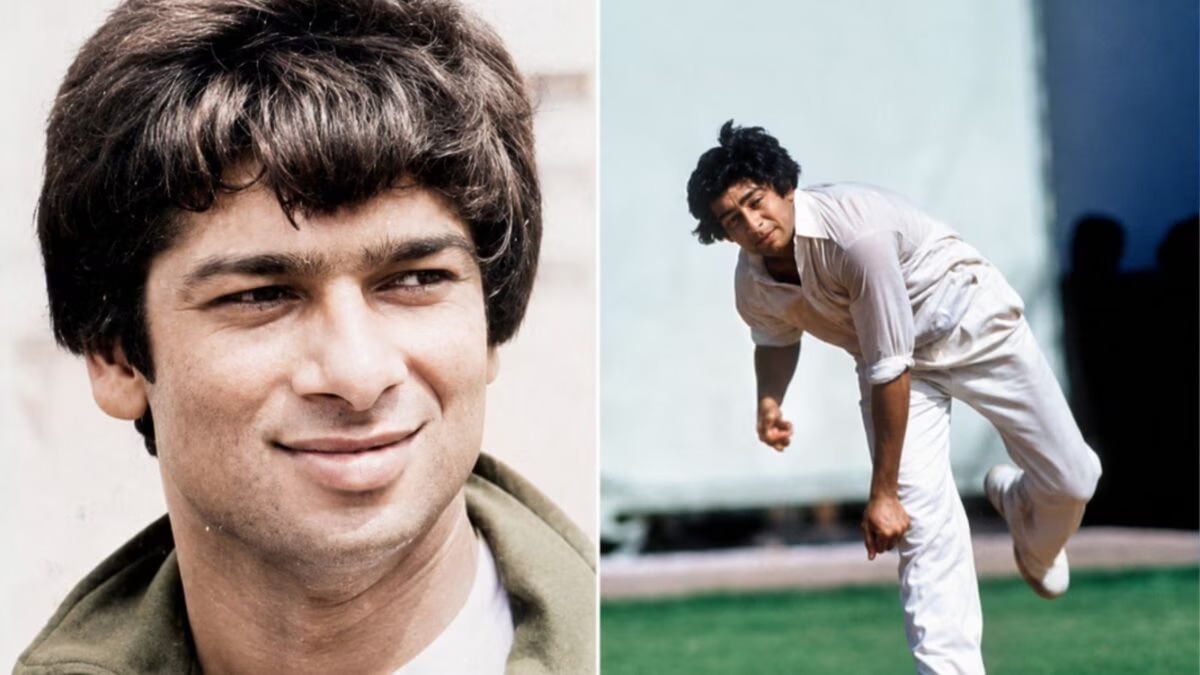
New Delhi. In the 1970s and 80s, when the Indian cricket team used to take the field, there was one player whose physique and looks were no less than a film star. That name was Karsan Ghavri, with hair flowing in the wind, a fierce personality and amazing confidence on his face. But Ghavri was not just a hero with his looks, but when he came on the field with the ball in his hand, he became the trouble-shooter of the Indian team like a true ‘superhero’. In the 1970s, when the Indian team was completely dependent on its spin quartet (Bedi, Prasanna, Chandrashekhar and Venkataraghavan), Karsan Ghavri took charge of left-arm fast bowling and gave a new identity to the Indian fast bowling attack.
Karsan Ghavri took 109 wickets and scored 913 runs in 39 Test matches for India, while he took 15 wickets in 19 ODI matches. These figures are from the era when cricket was not played continuously like today. Ghavri became the first Indian fast bowler to cross the mark of 100 wickets in Test cricket.
Fear of speed and unique skill: Left arm spin with fast bowling.
Karsan Ghavri had that magical skill which is seen in very few bowlers in the history of cricket. He used to start the match with very fast and accurate swing bowling with his left arm. His rising balls and tremendous bouncers were enough to trouble the biggest batsmen of the world, but Ghavri’s real art was visible as the match progressed. As soon as the ball turned from old and shiny to rough, Ghavri would change his strategy. He would shorten the run-up of his fast bowling and start bowling dangerous left arm orthodox spin with the same old ball. Such an unmatched display of both fast bowling and spin with the same ball, in the same match, completely confused the batsmen of the world.
When the world’s giants were forced to kneel
In his career, Ghawari faced some of the most powerful and feared batsmen in the world and left them helpless with his pace and line-length. Be it West Indies great Vivian Richards, captain Alvin Kallicharran or Australian legend, Ghavri stunned everyone with his pace. His most memorable performance is considered to be the Melbourne Test match of 1981. In that historic match against Australia, Ghavri created a sensation by dismissing Australian opener John Dyson and captain Greg Chappell in two consecutive balls in the second innings. Taking the wicket of Greg Chappell at zero proved to be the turning point of the match, on the basis of which India won the match and leveled the series. Ghawari, along with captain Kapil Dev, laid a strong foundation for Indian fast bowling for many years.
Lower-order trouble-shooter: Useful contribution in batting
Ghavri was not just a bowler but a very useful all-rounder. Whenever the top batting order of the Indian team collapsed, Ghavri would come to the lower order and stand like a warrior. He had the ability to play big shots and knew how to spend time on the wicket. He has two half-centuries to his name in Test cricket, in which his highest score was 86 runs, which he made against Australia in Mumbai. Ghawari along with Syed Kirmani made a historic partnership of 127 runs for the eighth wicket, which put India in a strong position. His fighting batting proved to be a lifesaver for India on many occasions.
Even after retirement, he continued to serve Indian cricket as a coach and mentor and played a key role in making a domestic team like Saurashtra Ranji champion. Karsan Ghavri will always be remembered in the history of Indian cricket as a ‘superhero’ who taught the Indian team to win abroad with his speed, spinning balls and the power of the bat.